

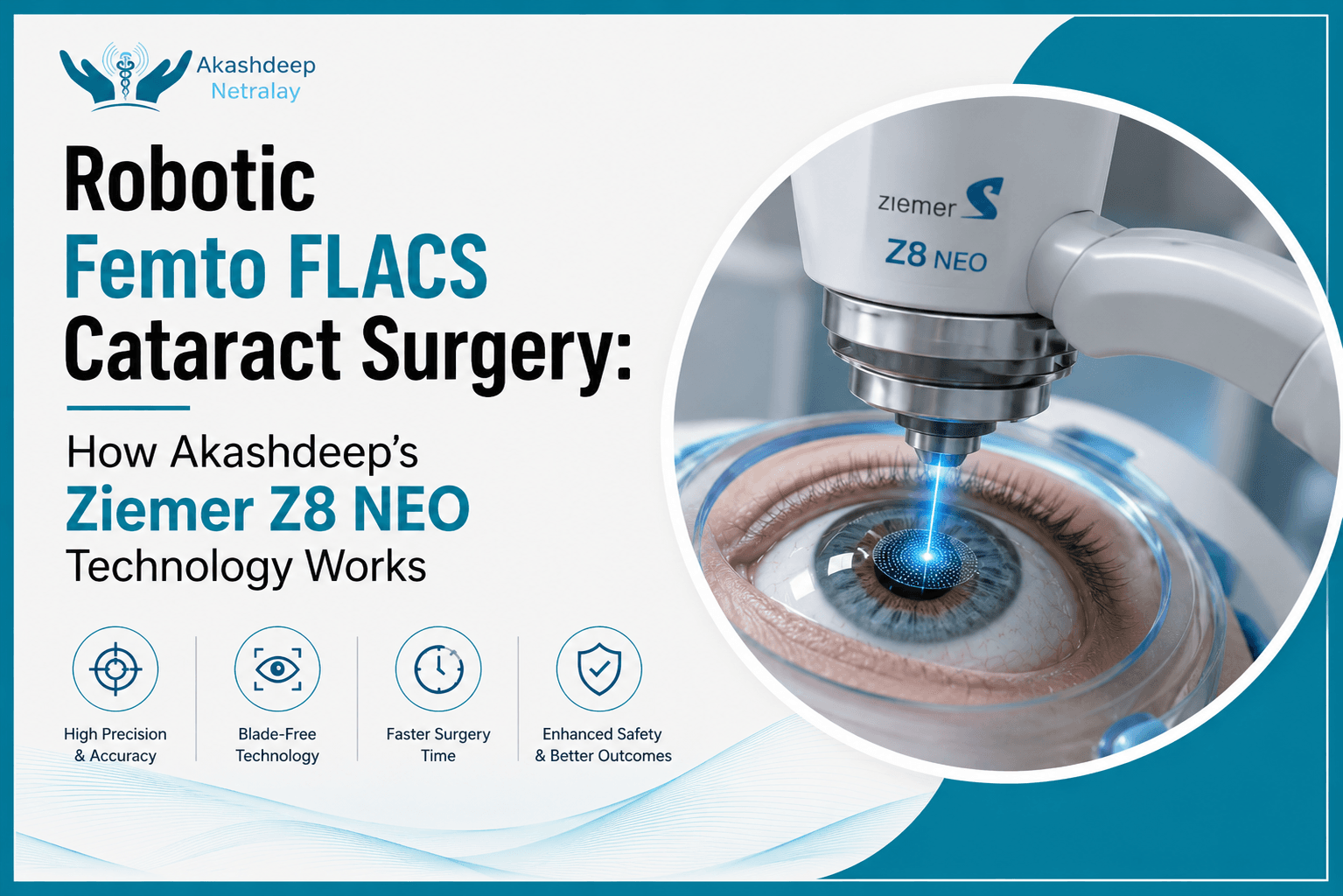
Blurred vision is one of the most common problems in people as a result of cataracts. If you have received a diagnosis of a cataract, chances are that you have read about the Robotic Femto FLACS Cataract Surgery in your research. The name sounds really advanced—and it is—but what does it actually mean for patients?
Basically, Robotic Femto FLACS Cataract Surgery uses digital eye maps and a femtosecond laser to carry out the most accurate operations during cataract surgery. In other words, instead of a purely manual approach, a laser performs some selected procedures according to the individually developed treatment plan of the surgeon. Thus, it allows to increase consistency and accuracy of treatment for suitable patients, but the surgeon is always in full control of the process.
At Akashdeep Netralay, Robotic Femto FLACS Cataract Surgery is performed using the advanced Ziemer Z8 NEO femtosecond laser platform. This Swiss-engineered system combines real-time OCT imaging with computer-guided laser technology to help the surgeon perform selected steps of cataract surgery with exceptional precision. It also allows the treatment plan to be tailored to each patient’s individual eye.
Every eye is different, though. The best surgical approach depends on a detailed eye examination, the type and severity of the cataract, the overall health of the eye, and the patient’s visual needs and lifestyle. After a thorough evaluation, the surgeon will recommend the technique that is most suitable for achieving the best possible outcome.
However, it is important to remember that everyone’s eyes are unique. The most appropriate surgical technique depends on a comprehensive eye exam, the type of cataract, overall eye health, and the patient’s needs.
What is a Cataract?
A cataract is a condition when the natural lens of the eye becomes cloudy. The natural lens of the eye should be transparent and help focus the light on the retina, providing clear vision. When the lens is cloudy, the vision gets blurred or foggy.
Common symptoms of cataracts are:
- blurred or cloudy vision;
- difficulties seeing at night;
- increased sensitivity to bright lights;
- faded or dull colors;
- changes in the glasses prescription;
- halos around lights while driving.
Cataracts typically develop gradually as a person ages, but they can also be the result of diabetes, eye injury, long-term use of steroids, or genetic conditions.
The only way to get rid of cataracts is their removal when the cloudy lens is replaced with an artificial intraocular lens (IOL).
What Is Robotic Femto FLACS Cataract Surgery?
Robotic Femto FLACS Cataract Surgery means Robotic Femtosecond Laser-Assisted Cataract Surgery.
It is the advanced type of laser-assisted cataract surgery in which a computer-controlled femtosecond laser is used to perform several surgical operations with extreme accuracy prior to cataract extraction.
What does FLACS mean?
FLACS consists of:
- Femtosecond;
- Laser;
- Assisted;
- Cataract;
- Surgery.
A femtosecond laser produces fast laser energy pulses that work on the eye tissues very accurately.
Why is it called robotic?
“Robotic” does not mean that the robot performs surgery autonomously.
The advanced imaging system provides a detailed 3D map of the eye. The surgeon examines the data, develops a plan for the procedure, and controls the laser. The laser then performs all its programmed operations very precisely under the guidance of the surgeon.
You may imagine that the advanced technology allows the surgeon to increase the precision of the surgeon’s operation—it cannot replace the surgeon’s skill.
How is it different from traditional surgery?
In traditional cataract surgery, some delicate operations are done manually with surgical instruments. In Robotic Femto FLACS Cataract Surgery, the laser assists with selected operations such as the creation of precise cuts in the lens capsule and the softening of the cataract prior to its removal.
The rest of the procedure, including removal of the cataract and implantation of the artificial lens, is carried out by the cataract surgeon.
Akashdeep Netralay’s Ziemer Z8 NEO Technology Explained
One of the features of modern cataract surgery technology is the high speed and precision of the femtosecond laser.
Meet the Ziemer Z8 NEO
At Akashdeep Netralay, Robotic Femto FLACS Cataract Surgery is performed using the Ziemer Z8 NEO, an advanced Swiss femtosecond laser system designed for laser-assisted cataract surgery. It combines Ziemer Z8 NEO technology with integrated real-time OCT (Optical Coherence Tomography) imaging, giving the surgeon a detailed view of the eye before the laser performs selected steps of the procedure.
The Ziemer Z8 NEO is designed to make precise corneal incisions, create a consistently accurate capsulotomy, and break the cataract into smaller pieces with a high level of precision. Throughout the procedure, the surgeon remains in complete control, using the technology to support careful planning and personalized treatment for each patient.
How does this technology help?
The potential advantages may be:
- precise laser-created surgical incisions;
- consistent treatment according to the digital plan;
- less energy needed to remove the cataract in many cases;
- accurate placement for selected advanced IOLs;
- comfortable patient experience;
- consistency during laser-assisted procedures.
While these advantages may be useful, results will differ depending on the density of the cataract, the eye’s condition, and the surgeon’s evaluation.
One of the standout features of the Ziemer Z8 NEO is its low-energy femtosecond laser technology, which delivers ultra-fast laser pulses with exceptional precision while minimizing unnecessary impact on the surrounding eye tissue. Combined with integrated OCT guidance and digital treatment planning, it helps the surgeon perform selected laser-assisted steps of cataract surgery with a high level of accuracy and consistency in suitable patients.
Step-by-Step Process of the Surgery
Knowledge of the procedure stages often decreases the feeling of fear before the surgery.
1. Comprehensive Eye Exam
Prior to the surgery, your ophthalmologist conducts a full exam of the eye, including:
Vision testing
Cataract evaluation
Measurement of the cornea
Checking eye pressure
Retina examination
Biometry for calculating lens power
These measurements will help you and your doctor to decide if the Robotic Femto FLACS Cataract Surgery is suitable for your eyes.
2. Digital Eye Mapping
Advanced technology provides you with a complete digital mapping of the eye, allowing the surgeon to plan the surgery based on the individual characteristics of your eye rather than the same approach to all eyes.
3. Personalized Laser Treatment Planning
The doctor examines digital maps and sets up the correct treatment settings of the procedure. Every detail is personalized – the location, size, and depth of the laser treatment.
4. Robotic Laser Creation of Precise Incisions
According to the treatment plan, the laser makes very precise incisions in the front portion of the lens capsule.
5. Cataract Softening
The laser splits and softens the cataract, making the cataract in small parts. Thanks to splitting and softening, less ultrasound energy can be used in the next phase of the surgery in some patients.
6. Cataract Removal
Your cataract surgeon gently removes the softening lens with the use of microsurgery techniques.
7. Advanced IOL Insertion
After cataract removal, an artificial intraocular lens is inserted into your eye. Your ophthalmologist may recommend certain types of advanced IOLs depending on your personal needs.
8. Final Check of Vision
Before finishing the surgery, the surgeon makes sure that the new lens is in place and everything is okay.
Benefits of Precise Planning in Cataract Surgery
Cataract surgery today is not only a process of removing the cloudy lens but also of helping patients get the best possible visual results.
Greater precision will help you with:
The exact placement of the intraocular lens
Exact alignment of premium lenses, if necessary
Conformity in surgical planning
Decrease in variability at the selected laser-assisted steps
Personalization of the treatment based on the exact measurements of the eye
For those who choose premium cataract surgery, precision can become particularly helpful since the positioning of the lens can have an impact on your vision quality.
However, technology is not the only thing that can help you get good vision after cataract surgery. Proper patient selection, pre-surgery examinations, and an experienced surgeon are also vital.
Comparison of FLACS vs Phaco Procedures
Many patients compare FLACS vs phaco before choosing cataract treatment.
| Characteristic | FLACS (Robotic Femto FLACS Cataract Surgery) | Conventional Phaco |
| Technology | Femtosecond laser combined with ultrasound | Ultrasound-based surgery |
| Use of Blade | Laser performs selected steps; some manual steps may be required | Manual surgical incisions |
| Precision | Laser-assisted surgical planning for selected steps | Depends on the surgeon’s surgical technique |
| Energy Usage | May reduce the ultrasound energy required in selected cases | Usually requires more ultrasound energy |
| Recovery Period | Recovery is often similar and depends on the individual patient | Recovery depends on the patient and is generally similar |
| Correction of Astigmatism | Can assist with selected corneal corrections | May require separate planning for astigmatism correction |
| Compatibility with Premium IOLs | Suitable for many advanced IOL procedures | Compatible with advanced IOL procedures |
| Suitability for Surgery | Depends on the patient’s eye condition and medical evaluation | Suitable for many cataract patients, depending on medical evaluation |
There is no universal cataract procedure that can be applied to everyone. Comparison of FLACS vs phaco should be done on the basis of a comprehensive eye exam and recommendation of your ophthalmologist.
Role of Advanced IOLs
Apart from removing the cloudy lens, choosing the right replacement can significantly affect your vision after cataract surgery.
Monofocal IOLs
These lenses provide clear vision at only one fixed distance – generally, for distance vision. However, reading glasses will still be required.
Multifocal IOLs
These lenses help in achieving good vision at various distances, possibly decreasing the requirement for glasses for the right candidates.
Toric IOLs
If you have astigmatism, then Toric lenses can work well for you as they address your cataract and corneal astigmatism.
Extended Depth of Focus (EDOF) IOLs
EDOF lenses provide a continuous vision range and help in making many patients see well in both intermediate and distant ranges of vision, thus lowering their dependence on glasses for daily activities.
The choice of the right advanced IOL depends on your eye condition, lifestyle, occupation, and visual requirements.
Robotic Femto FLACS Cataract Surgery – Who Can Be Helped?
Though there are plenty of advantages of Robotic Femto FLACS Cataract Surgery, it isn’t the perfect choice for all patients. Based on a complete eye examination, the suitability of the surgery can be determined.
Patients who may benefit include:
- Those suffering from age-related cataracts
- Professionals having high demands for vision quality
- Those looking forward to achieving premium vision using the right advanced IOLs
- Patients having astigmatism of particular types
- Individuals willing to undergo premium cataract surgery
- Those preferring a technology-assisted approach to treatment
Is the Procedure Safe?
Currently, cataract surgery is amongst the most common eye surgeries being performed worldwide. If done by an experienced ophthalmologist after careful evaluation, both conventional phaco surgery and Robotic Femto FLACS Cataract Surgery are safe procedures.
In addition to the above factors, the femtosecond laser makes the surgery more precise in selected steps. The technology doesn’t replace the need for careful planning, surgeon’s expertise, and follow-up care.
Some of the safety factors include:
- Thorough examination of the eye before surgery
- Advanced imaging and treatment planning
- Surgical procedures that are sterilized
- Selection of the right intraocular lens
- Timely follow-up visits
There are some risks involved in any kind of surgery, such as infection, inflammation, swelling, or increased eye pressure. These are rare complications, and your ophthalmologist will discuss the pros and cons of the surgery before you undergo it.
Why are Patients Opting for Laser Cataract Treatment in Western Maharashtra?
As the awareness regarding eye care keeps increasing, many people research laser cataract treatment in Western Maharashtra before opting for surgery.
They seek:
- Modern cataract surgery technology availability
- Experienced ophthalmologists
- Personalized treatment plans
- Advanced diagnostic technologies
- Premium cataract surgery availability
- Pre-operative evaluations
For many families, getting advanced cataract surgery in western Maharashtra means they get modern eye care near their homes.
At Akashdeep Netralay, the treatment plan is decided according to the eye condition and requirements of the patient, instead of a generalized recommendation.
Frequently Asked Questions
Is Robotic Femto FLACS Cataract Surgery painful?
As the eye is numbed with anesthetic eye drops before the surgery, most patients don’t experience any pain. They might feel pressure and flashes of bright light during the surgery; however, sharp pain is rare. Mild irritation after surgery can settle down within a day or two.
How long does the surgery take?
It usually takes between 15 and 30 minutes, but you spend more time in the hospital since preparation and recovery are also a part of the whole process. Most of the patients leave the hospital on the very day.
When can I resume my normal activities?
The patients can resume their light daily activities within a day or two. Though, till your doctor gives the green signal, avoid heavy lifting, swimming, rubbing your eyes, and dusty environments.
Is FLACS better than phaco?
Though both surgeries are quite effective, it is not an issue of the latest technology but selecting the best option for your cataract, eye condition, and vision requirements. Your ophthalmologist will prescribe the best procedure for you.
Will I require glasses after the surgery?
This depends on the IOL you opt for. Some patients continue to use reading glasses after the surgery, whereas other patients who get the right advanced IOLs might reduce their dependence on glasses. It varies from one patient to another.
What is an advanced IOL?
It is an advanced artificial lens that provides better vision at different distances or addresses astigmatism. Multifocal, toric, and EDOF are some examples of advanced IOLs. Your doctor will recommend the right one for you after evaluating your eyes.
Is the surgery suitable for everyone?
No. Though Robotic Femto FLACS Cataract Surgery is helpful for many patients, it isn’t the best choice for all patients. Based on your eye condition, history, and surgeon’s assessment, eligibility can be determined.
How long does it take to recover?
Though many patients start seeing clearly within a few days, some may require several weeks for complete healing.
What is the Ziemer Z8 NEO?
The Ziemer Z8 NEO is an advanced Swiss femtosecond laser system used at Akashdeep Netralay for Robotic Femto FLACS Cataract Surgery. It combines Ziemer Z8 NEO technology with real-time OCT (Optical Coherence Tomography) imaging and computer-guided treatment planning, giving the surgeon a detailed view of the eye before performing selected laser-assisted steps of cataract surgery.
The technology is designed to support greater precision and consistency during these steps, while the surgeon remains in complete control of the procedure from start to finish.
Conclusion
Deciding on cataract surgery is one decision that requires you to be well-informed to make it confidently. Robotic Femto FLACS Cataract Surgery incorporates digital planning and femtosecond laser technologies to help perform certain aspects of the procedure, thus providing precise and customized care for patients who meet the requirements.
However, apart from technology itself, the successful completion of the procedure is also facilitated by such factors as a complete eye exam, surgical planning, an advanced IOL, and a skilled cataract surgeon.
Regardless of whether you are making comparisons between FLACS and Phaco, looking for information on laser cataract western Maharashtra, or just starting to research cataracts, one thing that matters the most is professional guidance.
In case you decide to undergo the procedure and want to know what option is the right one for your eyes, contact the doctors of Akashdeep Netralay to receive a complete evaluation.
Akashdeep Netralay
📞 9100531005
✉️ support@akashdeepnetralay.com