

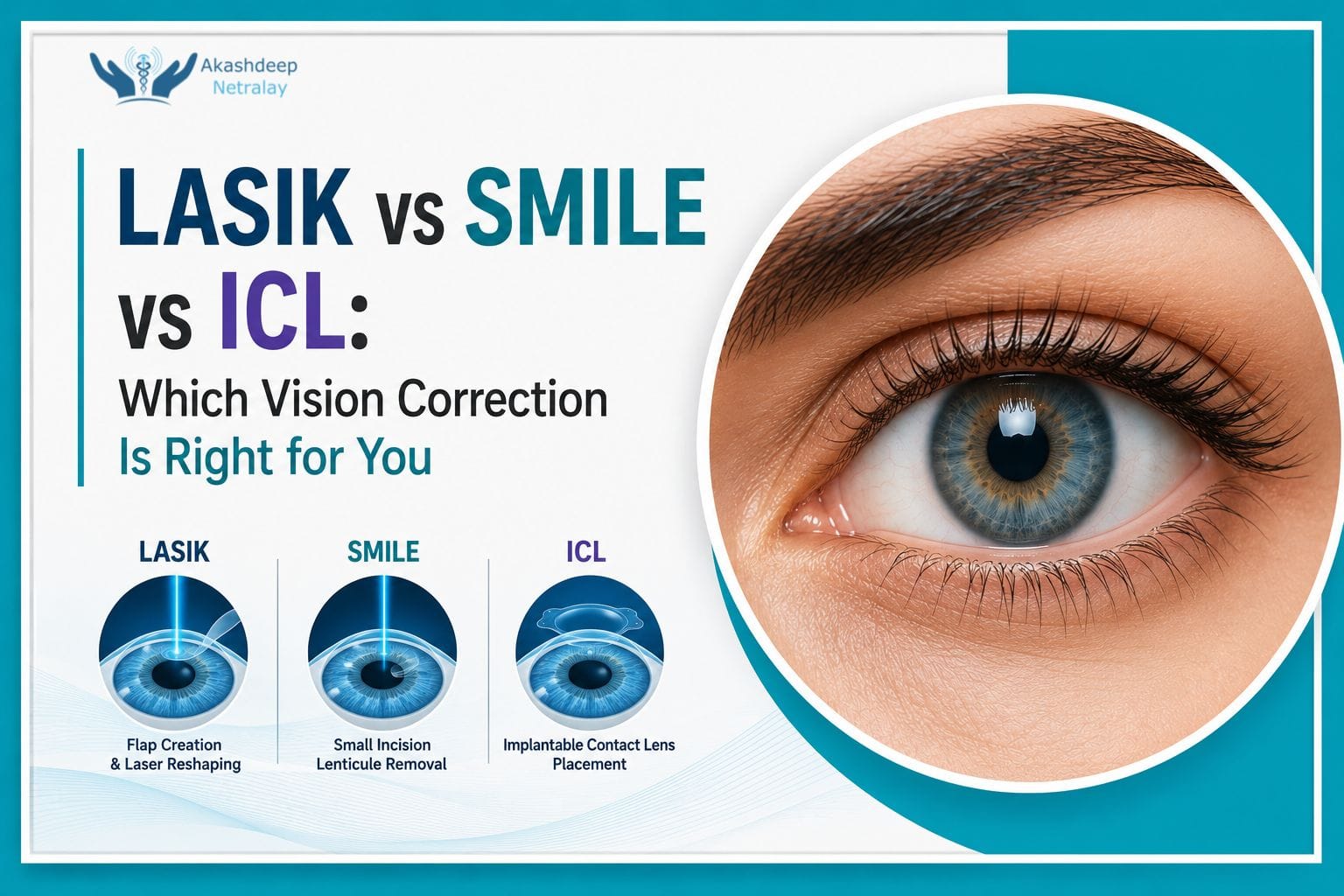
With the rising trend in specs-free surgery in India, an increasing number of people become interested in modern vision correction surgery, regardless of the reason, whether this is too much time spent in front of computers or an active way of life, or even simply the desire for convenience.
In searching for the answer to “LASIK vs SMILE”, you may find another equally effective option – ICL (Implantable Collamer Lens). Each of these methods is aimed at refractive error correction; however, each is different in certain aspects, including the eye power, corneal thickness, and other parameters.
In 2026, laser eye surgery in India underwent significant improvements in safety, accuracy, and customization. This guide will help you to understand the essence of LASIK, SMILE, and ICL and make your decision.
Vision Correction Surgery Explained
Reasons For Vision Correction Procedures
There are several reasons why people may prefer to undergo vision correction surgery:
- Freedom from the necessity to wear glasses during everyday activities
- Dependence reduction from contact lenses
- Enhancement of convenience while traveling
- Improvement of your performance in sports and physical activities
- Higher confidence and comfort
- Correction of eye power for a long time period
All of these reasons are united with the main goal – achieving visual freedom without constant wearing of eyeglasses.
Who Is Eligible For Eye Power Correction Surgery?
If you are thinking about undergoing a surgery of this type, then you may become a candidate for permanent vision correction in case of:
- The age of more than 18 years
- Stable eye power for at least one year
- Good condition of eyes
- The absence of untreated eye diseases
- Approval after a complete eye examination
LASIK Eye Surgery: What Is It?
Mechanism Of LASIK Surgery
LASIK (Laser-Assisted In-Situ Keratomileusis) is one of the most popular types of surgery that helps to correct myopia, hyperopia, and astigmatism.
The course of this procedure consists of the following stages:
- Thin corneal flap creation.
- Reshaping the cornea using the excimer laser.
- Repositioning of the flap without stitches.
It usually takes around 10–15 minutes to conduct surgery for both eyes. Also, most patients get improved vision within 24–48 hours after the procedure.
Advantages of LASIK Surgery
- Short procedure
- Fast recovery
- Proven effectiveness
- Broad scope of prescriptions
- Low level of discomfort
Disadvantages of LASIK Surgery
- Require appropriate corneal thickness
- Dry eye symptoms are possible for a short period after the surgery
- Some risks related to the flap
- Not perfect for some contact sports participants
SMILE Eye Surgery: What Is It?
Mechanism Of SMILE Surgery
SMILE (Small Incision Lenticule Extraction) is a relatively new advanced method of eye surgery.
The steps of SMILE surgery are the following:
- Creation of a lenticule using a laser.
- Removal of lenticule with the aid of a small incision in the cornea.
- The procedure does not include corneal flap creation.
Most patients recover quickly after SMILE and return to their routine activities in a couple of days.
Advantages of SMILE
- Small incision
- Reduced influence on corneal nerves
- Low risk of developing dry eyes
- Perfect for physically active patients
- No corneal flap
Disadvantages of SMILE
- This surgery cannot be applied to all patients, depending on their prescriptions
- Not all cases allow performing enhancements
- The availability of technology may vary depending on the clinics
LASIK vs SMILE: Main Differences Explained
Procedure Technology
During the LASIK procedure, a corneal flap is created, while during the SMILE procedure, it is absent.
Recovery Period
The recovery period of these procedures is rather quick. However, while LASIK offers fast visual improvement, SMILE can be associated with a little bit milder process of healing.
Risk of Developing Dry Eyes
The risk of having dry eyes is lower during SMILE, as less influence on corneal nerves occurs during this procedure.
Comfort During Recovery
The level of discomfort during recovery is low for most patients; however, this experience may vary in each particular case.
Eligibility For Physically Active Patients
As the SMILE procedure does not require the creation of a corneal flap, this procedure is perfect for athletes and contact sports players.
Long-Term Effectiveness
Long-term effectiveness is excellent in both cases, provided that the selection of patients is appropriate.
Cost Considerations
SMILE surgery is more expensive than conventional LASIK due to advanced technology. The price varies depending on the clinic, technology used, and the patient’s demands.
| Feature | LASIK | SMILE |
| Corneal Flap | Yes | No |
| Size of Incision | Larger | Small |
| Recovery Period | Very Fast | Fast |
| Dry Eye Risk | Slightly Higher | Generally Lower |
| Eligibility for Sports | Good | Excellent |
| Technology | Established | Advanced |
| Long-Term Results | Excellent | Excellent |
ICL Surgery Explained
How Does ICL Work?
ICL (Implantable Collamer Lens) is short for Implantable Collamer Lens.
This procedure doesn’t involve reshaping the cornea. Instead, a specially designed lens is inserted inside the eye – behind the iris and in front of the natural lens.
The major benefit is that this procedure can be reversed whenever needed.
Advantages of ICL
- For very high prescriptions
- Great visual outcomes
- Cornea preservation
- Useful for people with thin corneas
- Reversible treatment option
Disadvantages of ICL
- It involves lens implantation
- Typically more expensive than laser procedures
- Necessitates follow-ups
- Not every patient is eligible
Comparing LASIK vs SMILE vs ICL
Which Procedure Is Better For Me?
LASIK Could Be the Right Choice If…
- Your corneas are thick enough
- Your prescription is within the range of the treatable values
- You need fast visual recovery
- You want a reliable eye surgery to remove glasses
SMILE Could Be the Right Choice If…
- You’re engaged in sports or physical activities
- You worry about dry eye symptoms
- You prefer minimally invasive surgery
- Your prescription allows you to undergo the procedure
ICL Could Be the Right Choice If…
- You have high eye power
- You have thin corneas
- You are not the right candidate for LASIK or SMILE
- You need a reversible vision correction option
The best choice can be determined only based on clinical criteria.
Criteria Doctors Look at Before Recommending Procedures
Doctors evaluate the following parameters prior to recommending the treatment:
- Thickness of your corneas
- Eye power and stability of your prescription
- Corneal mapping and topography
- Dry eye condition
- Age
- Occupation
- Lifestyle factors
- General eye health
At Akashdeep Netralay, specialists conduct diagnostic tests prior to recommending a treatment for you. That’s why patients receive the safest and most efficient vision correction surgery possible.
What’s New in Vision Correction Technology in 2026?
New technologies in vision correction keep developing.
Among recent achievements, we can highlight the following:
- New diagnostic imaging systems
- Even more accurate laser platforms
- Improvement of corneal mapping technology
- AI-powered treatment planning tools
- Updated patient screening protocols
- Greater personalization
All these advancements improve the accuracy and safety of treatments.
FAQ
No, neither of the procedures is universally better. While comparing LASIK vs SMILE, the choice should depend on your prescription, corneal properties, and lifestyle.
Yes, ICL is often recommended for people with high levels of myopia that cannot be corrected by laser procedures.
It takes just several days to get back to your usual activities. It depends on the particular procedure.
Yes, usually, it is. But there are age-related changes of the eye that may take place anyway.
Many patients with thin corneas could be better candidates for ICL. Nevertheless, eligibility should be confirmed via a comprehensive eye examination.
Conclusion
Comparing LASIK vs SMILE vs ICL, we can conclude that there is no universal procedure for everyone. While LASIK has proven itself well and allows rapid recovery, SMILE can be a good minimally invasive alternative and even helps with dry eyes. ICL could be an excellent choice for patients with thin corneas or high prescriptions.
The most crucial point here is a thorough evaluation by experienced eye specialists. At Akashdeep Netralay, every treatment recommendation is based on diagnostics, eye health, requirements of the prescription, and your lifestyle.
If you are looking for vision correction surgery and wonder what procedure would be the best for you, professional assistance can help you make the right decision.
Contact Akashdeep Netralay
📞 Phone: 91005 31005
📧 Email: support@akashdeepnetralay.com