


If your glasses have a very high minus number, then you might be wondering whether laser eye surgery is possible for you. You might have read that LASIK might not be suitable for very high spectacle power or that the cornea might not have enough thickness for the treatment using lasers.
Now you might think about one thing – “If LASIK is not suitable for me, then do I have any other option besides glasses and contact lenses?”
And here is the answer – possibly, yes.
In the case of highly myopic patients with a suitable eye condition, phakic lenses such as ICL (Implantable Collamer Lens) or IPCL (Implantable Phakic Contact Lens) might be considered as alternatives. Unlike LASIK, there is no reshaping of the cornea involved in these procedures, since a lens is implanted inside the eye while the natural lens is left intact.
When it comes to ICL surgery in Kolhapur, what matters isn’t only your spectacle power. What you need to determine is whether a phakic lens is safe for your individual eyes. The information contained in this article was collected based on the clinical brief for this article.
What Is Phakic Lens Surgery?
A phakic intraocular lens (phakic IOL) is an implantable artificial lens that is used to treat refractive error without surgical removal of the natural crystalline lens.
Imagine that a corrective lens is implanted inside the eye instead of being worn in front of it.
Most often we talk about two types of surgery:
- ICL – Implantable Collamer Lens
- IPCL – Implantable Phakic Contact Lens
These two types belong to a broad category of phakic intraocular lenses. Based on the specific design of the lens, it is implanted inside the eye without the removal of the natural lens. This means that the natural lens continues performing its normal function.
This is completely different from LASIK, when the cornea is permanently reshaped with the help of a laser.
Why Can Phakic Lenses Be Used for High Minus Power?
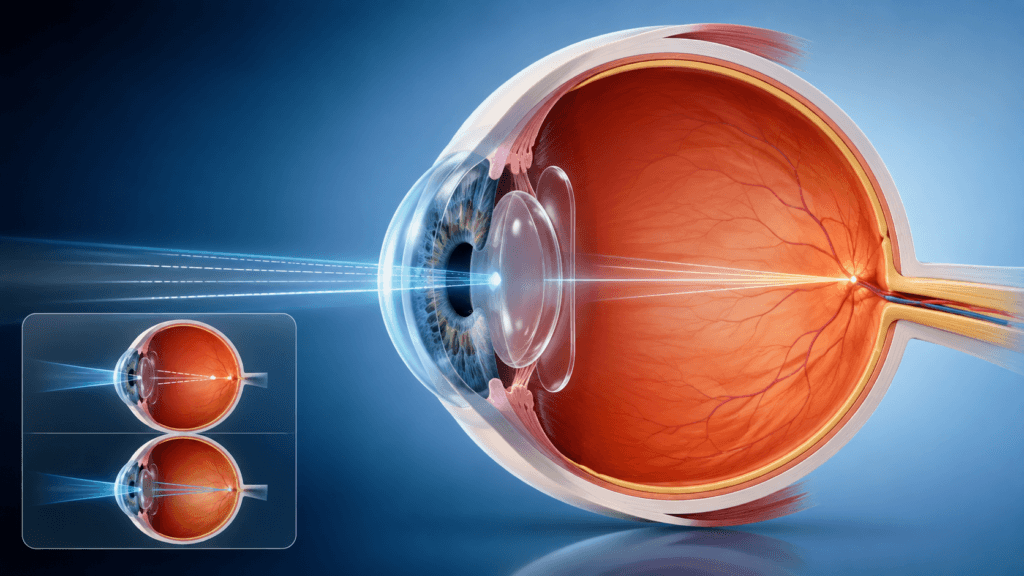
During the LASIK procedure, the cornea is reshaped with the help of a laser, and a certain amount of corneal tissue is removed. As the spectacle prescription gets higher, the amount and the pattern of the correction performed also get more complex.
Some patients, especially those with high minus power, might have corneal thickness, shape, or other characteristics of the eye that might make the laser correction unsuitable.
Other things observed during the eye exam might also affect the choice of the procedure.
But a high spectacle number doesn’t necessarily mean that you should use ICL or IPCL. There are patients with high prescriptions that can be successfully treated with the help of laser vision correction, while others with lower prescriptions have other corneal or anatomical parameters that make LASIK unsuitable.
Therefore, comprehensive eye measurements are important to choose the appropriate procedure.
ICL vs LASIK for High Power
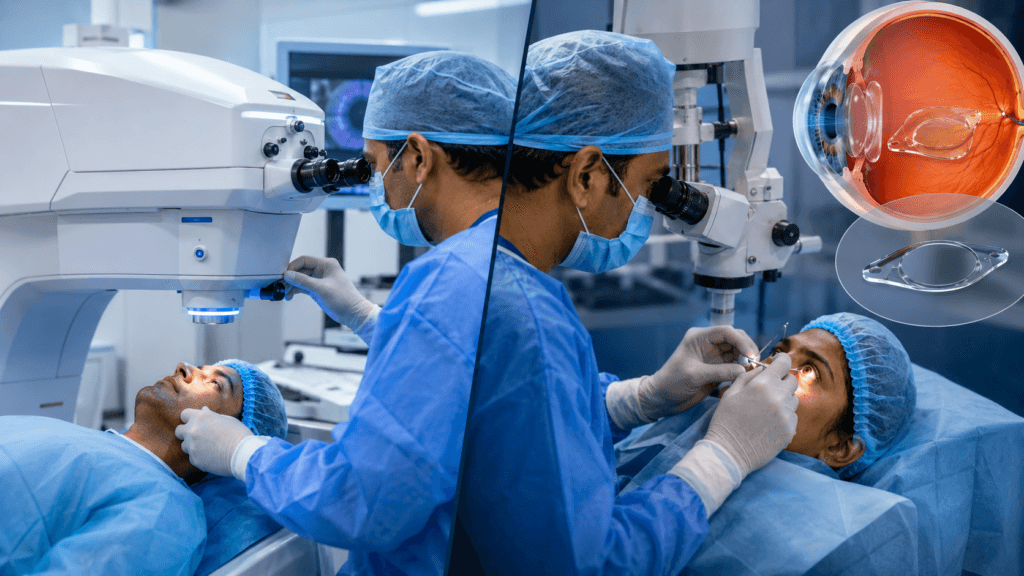
The simplest way to distinguish between the two procedures is to see what each of them changes.
LASIK
- Reshapes the cornea with the help of a laser.
- Removes a certain amount of corneal tissue.
- Can provide excellent results in properly selected patients.
- Might not be suitable for some people with high refractive error or unsuitable corneal thickness and shape.
ICL/IPCL
- Implants a corrective lens inside the eye.
- Does not reshape the cornea as LASIK does.
- Can be considered as an option for certain patients with moderate-to-high refractive error.
- Leaves the natural lens intact.
- Requires comprehensive eye measurements and an intraocular surgery procedure.
When people search for ICL vs LASIK high power, there is no single winner. The procedure depends on the patient’s cornea, refractive error, age, anterior segment measurements, and general eye health.
ICL vs IPCL: What’s the Difference?
While both ICL and IPCL are phakic lens implantation systems for correcting refractive errors, they differ in aspects such as materials, design, sizing, and optics.
ICL stands for Implantable Collamer Lens. IPCL is also a phakic lens that differs in its design and materials used.
There are some recent studies that give an affirmative result regarding the two lenses. A 2026 systematic review and meta-analysis based on nine studies and 1,187 patients showed that both IPCL and ICL have comparable visual and safety outcomes in myopic correction. However, according to the authors, more evidence is needed about the results in long-term use.
Previous comparative studies have shown comparable visual and refractive outcomes in properly selected patients.
The practical lesson here is simple: lens selection should be based on your eye parameters and evaluation made by your doctor, and not solely on the name of the lens.
Who May Be a Candidate for Phakic Lens Surgery?
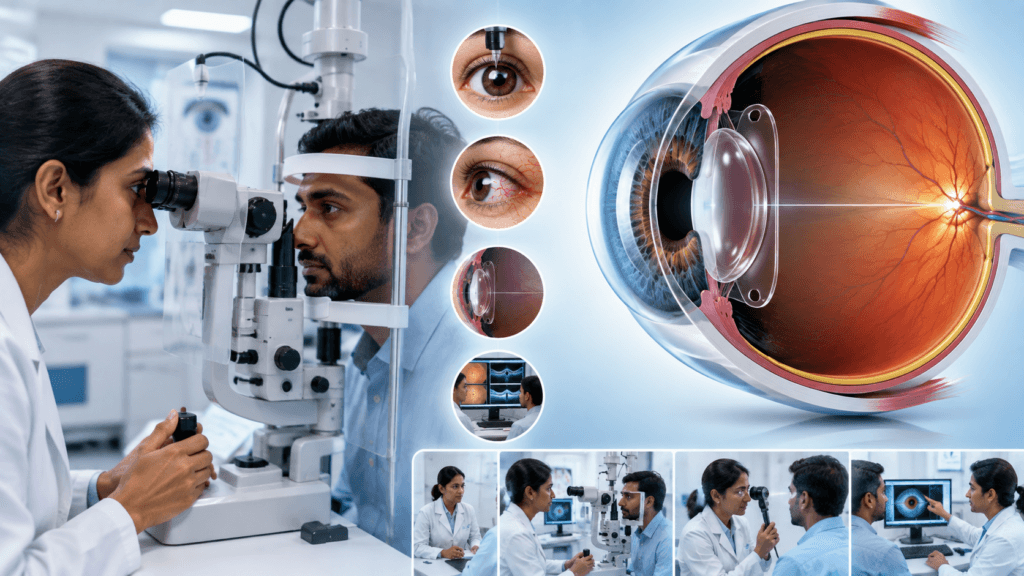
Candidacy is defined not by the strength of your spectacle prescription, but by the result of your comprehensive eye examination. Your ophthalmologist may take into account the following parameters of your eyes:
- Stability of your spectacle prescription
- Corneal thickness and morphology
- Anterior chamber depth
- Eye pressure
- Corneal endothelial cell density
- General eye condition
- Retinal health, if necessary
- Age and visual needs
- And others required to select and size the lens
For instance, anterior chamber depth and endothelial cell density are of great importance since the implanted lens should have enough space, and the cornea should have an appropriate amount of endothelium. Also, there is some regulatory data for ICL systems that specify anatomical and refractive eligibility requirements.
Thus, your surgeon may recommend ICL, IPCL, LASIK, another procedure, glasses, or contact lenses, taking into account the findings.
What Happens During ICL/IPCL Surgery?
Though the exact technique may vary, it usually consists of the following stages:
- Preoperative examination and eye measurements.
- Selection and calculation of the lens in accordance with your anatomical and refractive features.
- Eye numbing by means of proper anesthesia.
- Insertion of the lens by making a small surgical incision.
- Placement of the lens inside your eye.
- Postoperative examination and prescribed medications.
- Follow-up visits to monitor the healing process, eye pressure, position of the lens, and your vision.
The recovery process may be different for each patient.
Generally, many people can return to normal daily activity relatively fast if it is allowed by your surgeon, but you should follow the individual recommendations provided after surgery, and not rely on the general timeline.
Is Phakic Lens Surgery Reversible?
One of the advantages of phakic lenses is that they can usually be removed or replaced, if necessary.
This differs from LASIK, which irreversibly changes the shape of the cornea.
But “reversible” does not mean “safe”.
Lens implantation implies surgical intervention inside your eye, and removal or replacement of the lens implies another procedure. It also does not guarantee that it will wipe out all possible effects of the procedure.
What Are the Benefits of ICL/IPCL?
If the patient is selected correctly, he or she may get the following advantages from ICL/IPCL surgery:
- An option for people with high refractive errors.
- Absence of corneal tissue removal, like during laser corneal reshaping.
- Reduced need for glasses or contacts.
- Preserving the natural crystalline lens.
- Another option when LASIK is not recommended.
- Ability to remove or replace the implanted lens if it is medically necessary.
Phakic lenses are important since they are able to correct high spectacle prescriptions and preserve the natural lens. The European Society of Cataract and Refractive Surgeons calls phakic IOL implantation an effective treatment for high spectacle prescriptions, especially for young patients, unsuitable for laser eye surgery.
What Are the Risks and Limitations?
Remember that the procedure of ICL/IPCL is intraocular, and not just another type of contact lens.
The possible complications include:
- Increase in eye pressure
- Inflammation
- Changes in the number of corneal endothelial cells
- Corneal conditions in severe cases
- Cataract formation
- Problems with the placement or sizing of the lens
- Need to replace the position of the lens, or even replace it
- Presence of glare, halos, or other disturbances in vision of some patients
According to the FDA, the possible risks of the phakic IOL procedures include increased intraocular pressure, endothelial cell loss, corneal changes, and glare or halos.
That is why patient selection and regular follow-up are so important. A good IPCL review or ICL should take into consideration not only visual outcomes but the anatomy and risks of the patient.
How Much Does an Implantable Collamer Lens Cost in India?
There is no uniform ICL cost in India for all patients.
The actual cost depends on:
- Type and model of lens
- Correction of astigmatism or not
- Diagnostic examinations
- Surgeon and hospital
- Facilities and equipment used
- Treatment of one or both eyes
- Postoperative costs and medical expenses
Instead of using a general price advertised online, it is preferable to undergo a consultation and get an individually calculated quote taking into account the choice of lens and procedure for your eyes.
ICL/IPCL Surgery in Kolhapur, Sangli and Miraj
Those who look for information on ICL surgery in Kolhapur, IPCL surgery in Sangli, or phakic lens Miraj may see many offers and prices online.
The first step should not be to compare advertisements. It is to compare the quality and completeness of the eye examination.
Akashdeep Netralay offers one of the eye-care options in the area where you can talk about refractive surgery and have an examination to check whether you will benefit from ICL, IPCL, or any other procedure.
In case you want to explore health-content-related topics and questions, gptonline.ai could also be a useful source of information.
Is ICL/IPCL Better Than LASIK?
It is one of the questions that needs to be answered accurately.
ICL/IPCL is not always more advantageous than LASIK, and LASIK is not always more advantageous than ICL/IPCL.
A person with healthy corneas, having sufficient thickness and proper shape, may be an ideal candidate for LASIK. Another patient with a high refractive error, improper corneal parameters, or other problems may be offered ICL/IPCL.
The right question should not be:
“Which surgery is more advantageous?”
It should be:
“Which procedure is safer and more appropriate for my eyes?”
And the only way to know this is to have a comprehensive examination.
Frequently Asked Questions
Is ICL better than LASIK for high minus power?
It is not always. ICL may be considered in cases where a patient has a high prescription or improper corneal parameters, making the laser surgery inadvisable. Nevertheless, some patients with high prescriptions may have enough of the appropriate eye anatomy for LASIK.
Can ICL or IPCL correct very high spectacle power?
Phakic lenses can correct medium-high myopia, and there are some models which are intended to treat large refractive errors. Still, the actual correction range depends on the lens, individual anatomy of the eye, and regulatory approval, and therefore high spectacle power cannot be guaranteed to be corrected.
Is ICL surgery safe?
ICL surgery is a well-known procedure that has proven clinical efficacy, but it is still intraocular surgery and carries certain risks. Careful screening, proper lens sizing, and regular check-ups are essential to keep it safe.
How long does it take to recover after ICL/IPCL surgery?
Recovery period varies among patients and depends on the individual eye and procedure. In many cases, it is possible to return to normal activities relatively quickly when it is allowed by a surgeon, but the exact period should be discussed during postoperative care.
Is phakic lens surgery reversible?
The implanted lens can be safely removed or replaced in case of necessity. However, it does not mean that the procedure is risk-free, and removal does not negate all surgical effects.
How much does ICL surgery cost in India?
There is no universal price. The cost depends on the lens, the need for astigmatism correction, diagnostic procedures, the surgeon and hospital, and one-eyed or two-eyed surgery.
Can I undergo ICL/IPCL if I have thin corneas?
Not necessarily. The condition of a thin or unfit cornea could be one of the reasons that disqualify a person from being a candidate for laser corneal procedures. Therefore, ICL/IPCL could be considered, although they have their own anatomical requirements.
How do I know whether I am suitable for ICL or IPCL?
You need to undergo a thorough evaluation of your refractive error and general eye health. An ophthalmologist will take into consideration your prescription, the state of your cornea, anterior chamber depth, cornea endothelial cell count, eye pressure, and the overall health of your retina prior to recommending the right procedure for you.
Conclusion
Even having a high negative power doesn’t make thick glasses or lenses your only two options. Some people are good candidates for laser vision correction surgery, and others are better off going with either ICL or IPCL.
The main thing is that the choice should be made based on your eye condition – not only your spectacle number.
If you are looking for ICL surgery in Kolhapur, IPCL surgery in Sangli, or phakic lens in Miraj, then you need to undergo an eye examination first and discuss all possible options for you with an ophthalmologist.
At Akashdeep Netralay, you can discuss your needs for refractive correction and find out whether you should get either ICL/IPCL or LASIK.
Akashdeep Netralay
Contact: 9 1005 3 1005
Email: support@akashdeepnetralay.com